





































Ion Source from DREEBIT Enables Precise Study of the Carbon Nucleus
16.12.2025
How big is an atomic nucleus? The question seems simple, yet achieving a precise answer rank among the biggest challenges in modern physics. Researchers from Technical University of Darmstadt, Germany, have now taken a major step towards solving this riddle for carbon: Using advanced laser technology and a highly specialized ion source from DREEBIT, the team has measured the size of the carbon-13 nucleus with record-breaking accuracy, six times more precise than previous electron-scattering experiments.
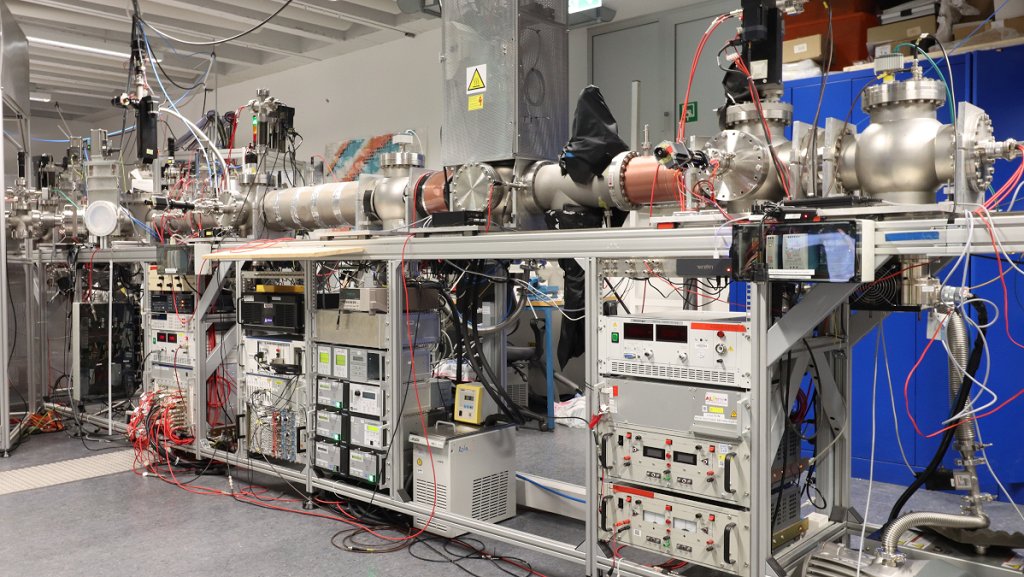
Photo: The COALA apparatus at the Technical University of Darmstadt, Germany.
Source: TU Darmstadt.
The rms charge radius of the carbon-13 nucleus is about 2.46 femtometers, determined with an uncertainty of roughly 2 – 3 x 10⁻³ fm, i.e., at the level of about one part in a thousand. A femtometer is one quadrillionth of a meter. That is to a meter what a tiny pinhead is to the entire solar system. Carbon-13 is ideal for studies of atomic nuclei because its properties make it uniquely suited for nuclear spectroscopy and tracer applications.
The experiment was conducted at the University’s COALA facility (Collinear Apparatus for Laser Spectroscopy and Applied Sciences). There, scientists used lasers to study carbon ions – atoms of carbon stripped of several electrons – and measured tiny shifts in the light they emitted. From these shifts, they determined how the positive charge is distributed within the nucleus. This charge radius describes the spatial distribution of electric charge in composite particles such as atomic nuclei and provides a measure of their size.
To create the necessary ion beam, the researchers relied on the Dresden EBIS-A electron beam ion source from DREEBIT. This system can produce highly charged ions of almost every element in the periodic table, delivering stable beams of protons, alpha particles, ions, and molecular fragments. For the carbon experiment, it supplied a pure and powerful beam of carbon-13 ions in exactly the right charge state for laser spectroscopy.
The researchers’ next goal is to apply their laser method with the DREEBIT electron beam ion source to carbon-14, aiming to measure its nuclear charge radius with accuracy comparable to their results for carbon-13. Since carbon-14 is radioactive and unstable – unlike stable carbon-13 – measuring its charge radius is more challenging but scientifically valuable. This measurement would improve knowledge of carbon-14’s nuclear structure by more than an order of magnitude compared to previous measurements, while simultaneously expanding the laser spectroscopy technique’s applicability to radioactive isotopes. The researchers aim to build upon their success with carbon-13 and extend precision nuclear measurements to the radioactive domain, which has important implications for nuclear structure theory and tests of fundamental physics.
“We are proud that our ion source helped enable this remarkable scientific achievement,” says Lars Großmann, Managing Director of DREEBIT GmbH. “It shows how our technologies support fundamental research that deepens our understanding of the universe – one atom at a time.”
Source: Pfeiffer Vacuum+Fab Solutions