






































Cloud technology could transform how CNC machines think
17.07.2026
A new cloud-based control architecture could reshape how CNC machines communicate, process data and respond to production conditions. Developed at the University of Illinois, the C-DNC framework links machine, client and cloud resources in a more integrated manufacturing environment.
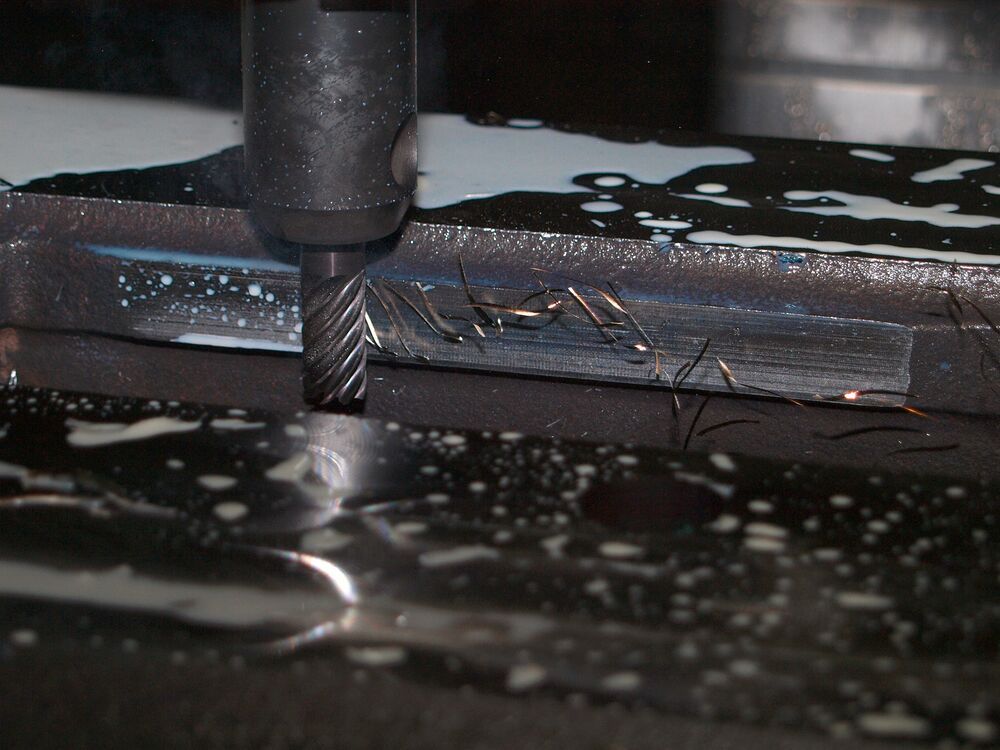 The Cloud-Direct NC (C-DNC) framework represents a fundamental rethinking of how machine control is done. Photo: Pixabay
At times, it might seem like the computing technologies that pervade the modern world are continually making a whirlwind of dizzying advances. But that isn’t always the case. Computer automation has long played a critical role in manufacturing, notably including the use of computer numerical control (CNC) to control machine tools. Yet despite the importance of CNC to industry, the fundamental approach underlying its use has remained unchanged for decades.
Placid Ferreira’s research group at the University of Illinois is now shaking up that status quo in a big way. They’ve introduced the Cloud-Direct NC (C-DNC) framework, which represents a fundamental rethinking of how machine control is done. The paper describing the framework just won a NAMRC Outstanding Paper in the Journal of Manufacturing Systems award, which was presented to the team at the 54th North American Manufacturing Research Conference (NAMRC).
In addition, through a new venture called Toolbit, Ferreira’s students Shivam Garg and Aryan Shroff are in the process of commercializing one application of the framework: a technology they call Numerical Control as a Service (NCaaS). That effort has already won another two awards.
What makes C-DNC so novel?
Ferreira, who is the Tungchao Julia Lu Professor in mechanical science & engineering and an affiliate of the Holonyak Micro & Nanotechnology Laboratory and the Coordinated Science Laboratory, explained that until now, there has been a dichotomy between hardware and software.
“On one side, in manufacturing, you have the machines, and on the other side, you have software, and there’s always been a sort of barrier between the two,” he said. “Sometimes, that barrier has been justified, as it’s good for security and so forth. But in general it fragments the flow of information. It introduces various kinds of breaks in the flow of information where somebody has to manually translate the file, or do something to a file to get a program to run on the machine.”
Ferreira said the team asked themselves a fundamental question: knowing what we know today in terms of cloud computing, high-bandwidth communications, emerging AI applications, affordable sensing options, and so on, would we still want to use the same old approach for CNC? Or would we do something different?
“We came to the conclusion that one has to have a much more sort of integrated view of how things are done, rather than ‘this is done in software outside the machine; this is done on the machine.’ And we developed and implemented an architecture which seamlessly... recruits cloud resources, it recruits client resources, it recruits embedded systems resources, and integrates them together to define a really seamless flow of information.”
Ferreira said the ultimate result will be that machines gain “the potential to be much smarter.”
“[A machine] can react to what is happening better,” he said. “It can learn from what it previously did more efficiently so it doesn’t do the same thing, it can compensate for its errors. It can become much, much more sensitive and perceptive with respect to its environment... And then by connecting it to client and cloud resources, it can analyze these data much more easily that it’s collecting. It can store and manage and curate this information much more easily. And it can access web resources to do learning algorithms and online learning. So you can have a much, much better integrated stack.”
Students Garg and Shroff have been strategizing about how to commercialize aspects of C-DNC. In Spring 2026, they took the Landuyt Center for Entrepreneurship’s course TE 598, Accelerating Deep Tech Enterprises, and used it as a springboard for developing plans.
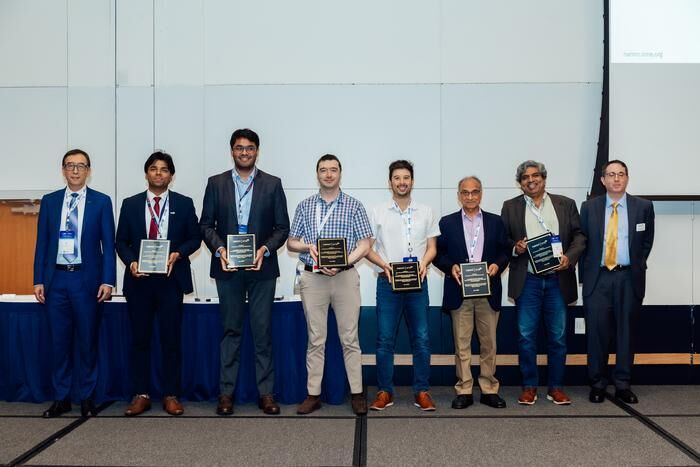 Six of the seven authors accept their NAMRC Outstanding Paper award on June 17, 2026. At the far left and far right are conference officials Xun Xu and Brett Conner. Holding the plaques are (left to right) authors Shivam Garg, Aryan Shroff, Ricardo Toro, Jorge E. Correa, Shiv G. Kapoor, and Placid M. Ferreira. Co-author Liang Tung Chen was not present. Photo source: Jason / Grainger College of Engineering at the University of Illinois Urbana-Champaign
Shroff explained that the C-DNC framework is an umbrella that implies a wide range of different sub-technologies. The piece that he and Garg are starting with, which they call Toolbit, is “the hardware device that essentially does the communication” between a company’s manufacturing machines and the C-DNC cloud architecture.
Toolbit ended up winning the 5,000 dollsrs third-place prize in the TE 598 competition. Earlier in the semester, the team also won an EnterpriseWorks Student Startup Tenancy Prize after Garg and Shroff presented the work at the Landuyt Center’s 2026 Cozad Demo Day. That prize includes access to co-working and conference spaces in EnterpriseWorks, the startup incubator at the University of Illinois Research Park.
Article source: www.etmm-online.com