







































Argonne advances additive manufacturing for high-temperature reactor components
17.08.2026
Researchers at Argonne National Laboratory, working alongside scientists from several other U.S. national laboratories, have taken a step toward expanding the use of advanced manufacturing techniques for next-generation nuclear reactors.
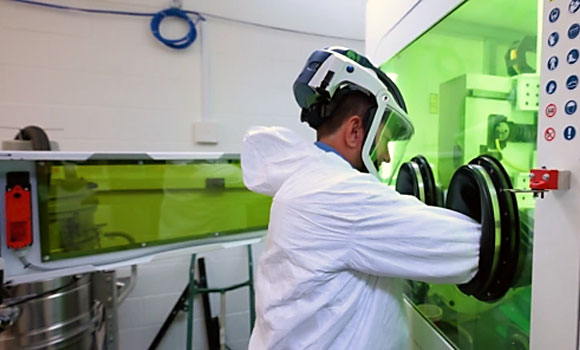 Photo: Argonne
The research has led to the submission of the first draft of an American Society of Mechanical Engineers (ASME) Code Case that would allow the use of Laser Powder Bed Fusion (LPBF) additive manufacturing for high-temperature reactor components.
The proposed approach could help accelerate the qualification and approval of materials while expanding their potential applications, contributing to the development of nuclear energy technologies that are safer, more reliable and more economical.
Why is the development significant?
LPBF is an advanced 3D-printing technology that can be used to manufacture components from high-performance materials. Its potential application in the nuclear industry represents an important development in materials science and advanced manufacturing.
For nuclear reactor components, the technology could help strengthen the supply chain while reducing manufacturing lead times. It could also provide engineers with greater flexibility when designing complex structural components intended to operate at high temperatures.
These advantages could become increasingly important as the industry works to develop and deploy advanced reactor technologies.
Collaboration across U.S. national laboratories
The work was carried out through a collaboration involving researchers from Argonne National Laboratory, Oak Ridge National Laboratory, Idaho National Laboratory and Los Alamos National Laboratory.
The research was conducted as part of the U.S. Department of Energy's Office of Nuclear Energy Advanced Materials and Manufacturing Technologies (AMMT) program.
AMMT investigates several advanced manufacturing approaches, including Laser Powder Bed Fusion (LPBF), Directed Energy Deposition (DED) and Powder Metallurgy Hot Isostatic Pressing (PM-HIP).
These techniques are being studied as potential ways to develop and process innovative materials while addressing some of the manufacturing challenges associated with nuclear energy applications.
Researchers at Argonne worked with colleagues participating in the AMMT program to translate research in advanced materials and manufacturing into technical standards and potential regulatory pathways. The effort is intended to help accelerate the eventual deployment of advanced reactor technologies.
Mark Messner, Xuan Zhang and Yiren Chen led the development, with contributions from researchers throughout the national laboratory system. The team conducted its work using Argonne's Additive Manufacturing Laboratory.
Machine learning could further accelerate qualification
Argonne researchers plan to continue exploring ways to shorten the material qualification process, including the use of machine learning.
The goal is to complement the more conventional empirical approaches used by ASME to correlate and extrapolate time-dependent material test data.
At the same time, researchers are working toward more advanced digital qualification methods that could combine in situ process monitoring, advanced data analytics and artificial intelligence tools.
The incorporation of machine learning and other AI-based technologies is also consistent with the U.S. Department of Energy's recently announced Genesis Mission. The initiative aims to connect supercomputing resources, data and national laboratories such as Argonne to accelerate scientific discovery, energy innovation and national security efforts.
The proposed ASME Code Case represents an important step in translating advanced manufacturing research into standards that could ultimately support the broader use of additively manufactured components in next-generation nuclear reactors.
Article source: www.anl.gov